
- Sitting concentrates pressure directly on the sciatic nerve’s path; the right cushion redistributes it.
- Our research-led pick is the ComfiLife Gel Enhanced cushion: 4.4 stars from more than 108,000 owners, with a U-shaped cutout that takes pressure off the tailbone.
- A cushion helps most as part of a sitting strategy: right height, feet planted, regular stand-up breaks.
- If your pain is new, worsening, or comes with leg weakness or numbness, get assessed before buying anything.
The best seat cushion for sciatica exists because chairs are quietly brutal. Sitting loads your body weight straight down onto the buttocks and tailbone, exactly the territory the sciatic nerve runs through, and if you have sciatica you already know the countdown: twenty minutes into a car journey or a desk session and the familiar ache starts creeping down the leg. We have written before about how to sit with sciatica; this guide covers the single product that makes those strategies easier to live with.
A good cushion does two mechanical jobs: it spreads pressure across the thighs instead of letting it pool under the sit bones, and it removes contact from the tailbone entirely via a cutout. Neither is a gimmick; both are the same principles pressure-relief seating uses in clinical settings.
How we chose the best seat cushion for sciatica
We compared the leading orthopedic cushions on foam quality and density, the geometry of the tailbone cutout, cover and grip (a cushion that slides around a chair is a cushion you stop using), and how they hold up under daily sitting, then went through the owner record in depth: more than 108,000 ratings on our pick, including the critical ones. Our own decade of pain-driven sitting tells us what matters; the crowd tells us how each cushion actually performs across thousands of bodies and chairs.
Top pick at a glance

ComfiLife Gel Enhanced Seat Cushion
The category benchmark: high-density memory foam with a cooling gel layer, a U-shaped tailbone cutout, a non-slip base and a washable cover. Rated 4.4 out of 5 by more than 108,000 owners, with comfort and pain relief the two dominant themes.
Check price on AmazonAs an Amazon Associate we may earn from qualifying purchases, at no extra cost to you.
✔ Pros
- Tailbone cutout genuinely unloads the coccyx and sciatic path
- Dense foam that does not flatten by lunchtime
- Non-slip base stays put on office chairs and car seats
- Washable cover, and a lifetime replacement promise from the maker
✖ Cons
- Firmness divides owners: supportive for most, too hard for some
- Raises your seat height an inch or two, check your desk setup
- Gel layer moderates heat but it can still warm up on long sits
Why sitting hurts sciatica, and how a cushion helps
When you sit, pressure concentrates under the ischial tuberosities (your sit bones) and the tailbone, and the piriformis and gluteal muscles the sciatic nerve threads through are squashed between bone and chair. Soft sofas make it worse by letting the pelvis roll backward, which flexes the lumbar spine and narrows the spaces nerves pass through. A shaped cushion counters this: dense foam spreads load onto the thighs, the cutout removes tailbone contact entirely, and a slight forward slope encourages the pelvis into a more neutral tilt.
What a cushion cannot do is fix the disc, joint or muscle problem generating your sciatica. It manages the sitting trigger, which for desk workers and drivers is often the biggest trigger of the day.
The ComfiLife in detail
The ComfiLife is the cushion every other cushion gets compared to, and the construction explains why. The core is genuinely high-density memory foam (the cheap knockoffs use light foam that pancakes within weeks), topped with a cooling gel layer. The U-shaped rear cutout floats your tailbone in free air, and the subtle contour guides the thighs without digging in. Underneath, a rubberized non-slip base keeps it planted, and the zip-off cover survives the washing machine, which matters for something you sit on daily.
It works on an office chair, a car seat, a wheelchair, a dining chair, anywhere sitting hurts. Owners routinely buy a second for the car, which tells you most of what you need to know about whether it earns its keep.
What 108,000 owners actually say
At the time of writing: 4.4 out of 5 across more than 108,000 ratings, with around two thirds of reviewers giving five stars. Comfort is the most-discussed theme by a wide margin (nearly 8,000 mentions), followed by pain relief at over 5,000, with tailbone pain and sciatica specifically called out again and again. Quality and value round out the picture: this is a cushion people describe keeping for years, not a seasonal purchase.
The honest complaints
- The firmness debate. The main split in reviews: most call it firm-but-comfortable, a persistent minority find it simply too hard, especially lighter users whose weight does not compress the foam much. If you know you prefer plush seating, consider the softer alternative below.
- Seat height. It adds a couple of inches. Tall desk users will not care; if your desk is already low, you may need to drop your chair to keep elbows and screen right (our ergonomic chair guide covers the geometry).
- Warmth on marathon sits. The gel helps, but foam is foam. Owners doing three-hour stretches sometimes mention heat, which is arguably your body’s way of saying get up and move anyway.
A softer alternative
Everlasting Comfort cushion, best if you find dense foam too hard
The other giant of the category (4.4 stars across more than 104,000 ratings), with a similar cutout design but a slightly softer, more contoured feel that suits lighter bodies and plush-seat lovers. The trade-off runs the other way: heavier users may bottom it out sooner than the ComfiLife. Check the Everlasting Comfort cushion on Amazon.
Who should buy it, and who should not
Buy the ComfiLife if sitting is your reliable sciatica trigger, your tailbone aches after desk days or drives, or you want one cushion that moves between office and car. Skip it if you strongly prefer soft seating (take the Everlasting Comfort instead), your pain is new or worsening with leg weakness or numbness (assessment first), or your problem is purely lower-back muscle ache when standing, where a cushion solves the wrong problem.
Getting the best from it
- Cutout to the back, always: the U opening cradles the tailbone.
- Re-check your desk geometry after adding it; drop the chair so elbows stay at roughly ninety degrees.
- Pair it with movement: a cushion buys you comfortable sitting time, it does not repeal the need to stand every 30 to 45 minutes.
- Feet flat on the floor. If the cushion leaves them dangling, use a footrest.
A premium alternative, if foam is not for you
The ComfiLife above is the better-value pick for most people and the one we recommend first. But memory foam is not the only approach, and if you run hot or simply dislike the sink-in feel of foam, there is a genuinely different premium option.
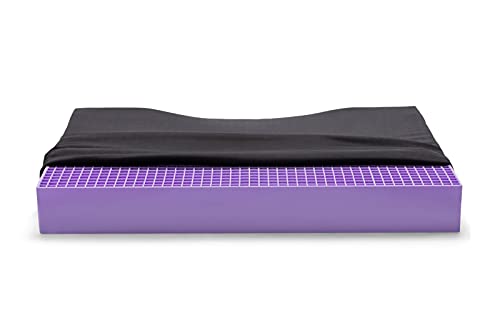
Purple Ultimate Seat Cushion
Instead of memory foam, Purple uses a flexible gel grid that collapses only under your sit bones while staying supportive elsewhere, and crucially it’s temperature-neutral, so it does not warm up the way foam does on long sits. Rated 4.4 out of 5 across more than 3,500 owners, with pain relief and sciatica the top praise. Honest caveats: it costs notably more, some find it firmer than expected, and a few report it slides on smooth chairs.
Our take: Choose it if you run hot on foam or want the distinctive gel-grid feel. For most tailbones, the ComfiLife does the same job for less.
Check price on AmazonAs an Amazon Associate we may earn from qualifying purchases, at no extra cost to you.
Frequently asked questions
Do seat cushions really help sciatica?
They help the sitting trigger, which for many people is the dominant daily trigger: less pressure on the sciatic path, less tailbone contact, better pelvic position. They do not treat the underlying cause, so think of one as trigger management inside a broader plan of movement, stretching and good sleep positioning.
Memory foam or gel for sciatica?
The best cushions use both: dense memory foam for support with a gel layer for temperature. Pure gel cushions feel novel but tend to lack the structured support a nerve-pain sufferer needs; light cheap foam collapses. Density is the spec that matters.
Why the U-shaped cutout?
It removes all contact between chair and coccyx, so the tailbone and the ligaments around it carry no load. If your pain flares from the tailbone outward, or you feel it most on hard chairs, the cutout is the feature doing the work.
Can I use it in the car?
Yes, and drivers are among its most enthusiastic owners. Check your head clearance and mirror positions after adding the height, and never let a cushion interfere with pedal reach or seatbelt fit.
Ready to try the ComfiLife?
If sitting is where your sciatica bites, this is the cheapest meaningful upgrade to every desk day and drive you will make.
The health information in this review is supported by the trusted medical sources below. It’s general information, not a diagnosis or medical advice. See our medical disclaimer.
Sources and further reading
Was this guide helpful?
Thank you. Your feedback helps us improve.