
Finding the best sleeping position for sciatica is one of the most common and most frustrating problems this condition creates. You are exhausted, you know sleep is exactly what your body needs to settle the pain down, and lying still is the one thing that sets it off.
We have lived with sciatica and lower back pain for years. What follows is what actually works for us night after night: a pre-bed routine, a positional trick a physical therapist gave us, the three positions worth using, the one to avoid, and the small details around them that make the difference between a broken night and a decent one.
Why sciatica feels worse at night
It’s not your imagination, and it’s worth understanding because it tells you what to do about it.
- You stop moving. During the day you shift constantly without noticing, and every shift relieves pressure for a moment. Lying still for hours lets pressure build on the same spot on the nerve.
- There is nothing else competing for your attention. Pain that was background noise while you were busy becomes the only thing in the room once the lights are off.
- Your position may be working against you. A soft mattress or a twisted hip holds the spine in a poor position for hours at a stretch, which is long enough to inflame an already irritated nerve.
- Muscles tighten as you cool down. The lower back and the piriformis in particular stiffen when you settle, and a tight piriformis presses directly on the sciatic nerve.
Every one of those is something you can influence, which is why the routine below matters as much as the position you end up in.
Three things we know for certain
- You must try to relieve sciatica before getting into bed
- You must sleep on a mattress that supports your spine correctly. No exercise in the world can fix a bad bed
- Gentle movement and positioning before bed make a real difference to how comfortable the night is
The Great Sciatica Sleep Fix
We call this the Great Sciatica Sleep Fix because it works for us nine times out of ten. We do it every single night without fail, and it’s the most effective thing we do to settle sciatica before bed. It also helps stop overnight flare-ups building in the first place.
It’s the only pre-bed exercise we use. We often stay in position for over thirty minutes because it’s such a passive, relaxing stretch. All you need is a large resistance band or elastic band.
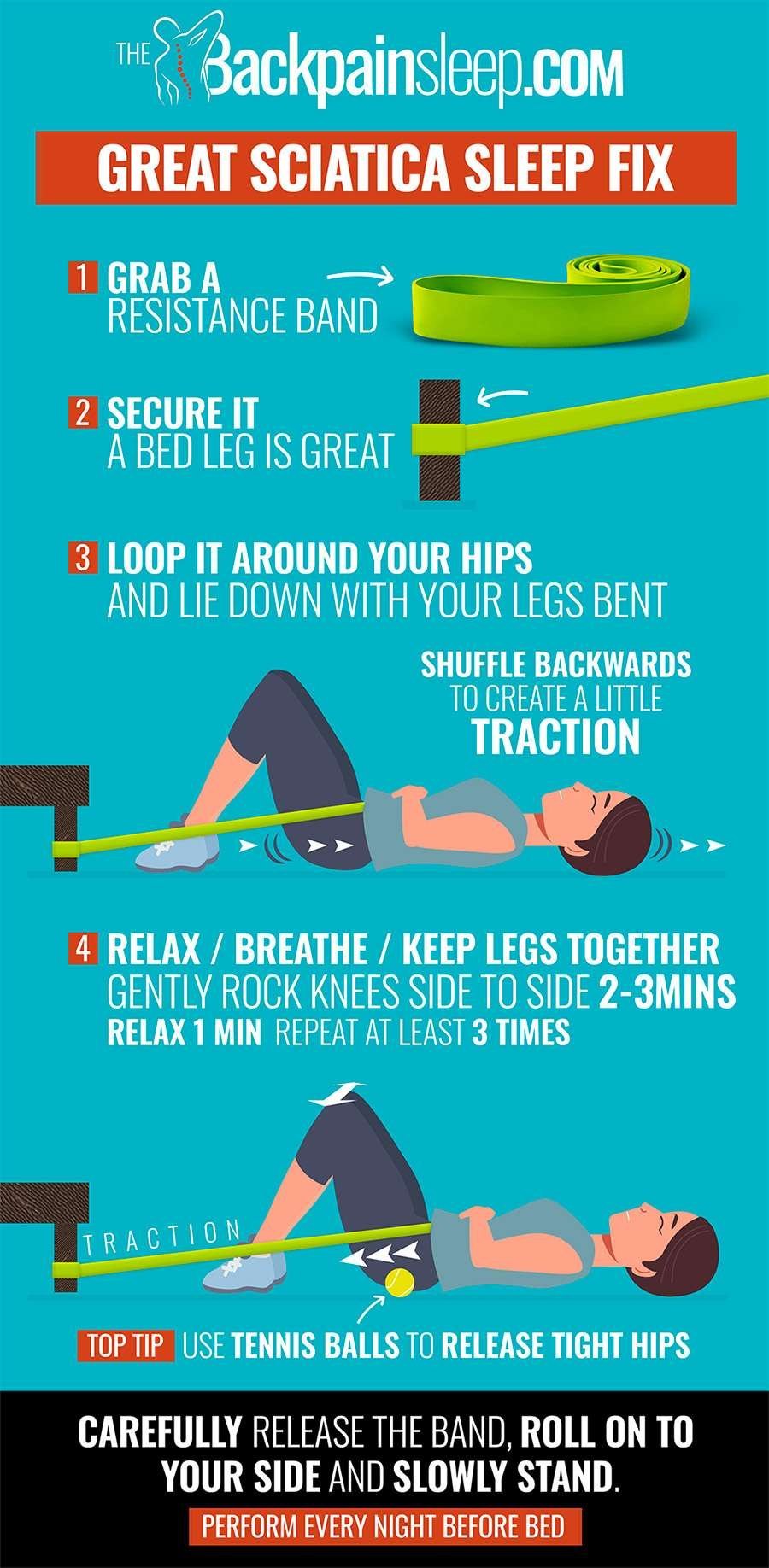
Important: do not do this during a severe flare-up. Wait until the acute pain has settled. Stop immediately if any movement causes a sharp increase in pain.
The Sciatica Sleep Shuffle
Once the Sleep Fix has primed your back for bed you may get comfortable straight away. But sciatica does not always follow the rules. This is where we use the Sciatica Sleep Shuffle, a tip a physical therapist gave us years ago that has been genuinely invaluable ever since.
Once in bed, lying on your back:
- Place a pillow under your knees
- Keeping your knees close together, shift your hips one or two inches away from the side of the pain
- Relax there for a few minutes, then reassess
If your sciatica runs down your right hip and leg, shift your hips a couple of inches to the left and relax. This small positional adjustment can bring real relief. If it has not eased after a few minutes, nudge a little further. It takes patience, but when it works it’s worth every minute.
The three best sleeping positions for sciatica
There are three positions worth your time. Which one suits you depends partly on what is causing the compression, so try them in order and give each one a couple of nights before you judge it.
1. Side sleeping with a pillow between the knees
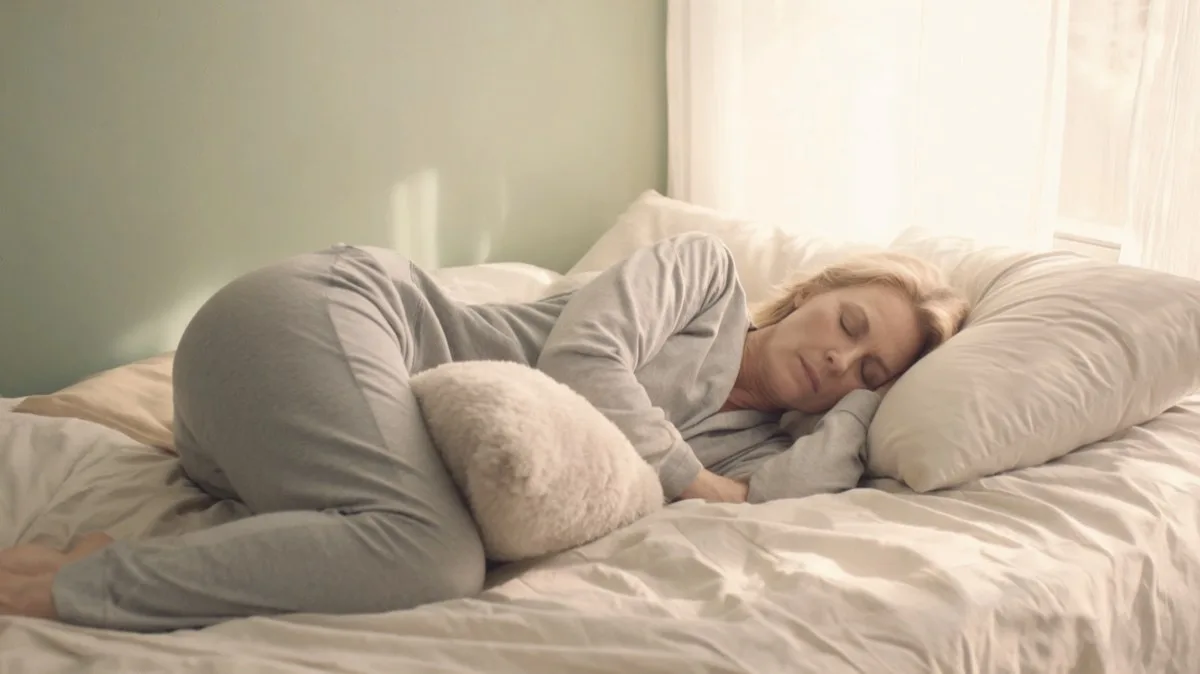
This is the position most often recommended for sciatica, and with good reason. Side sleeping reduces pressure on the lumbar discs compared with lying flat on your back, and a pillow between the knees stops the top leg dragging the pelvis forward and twisting the lower spine.
- Lie on the side opposite your pain if your sciatica is one-sided
- Place a firm pillow between your knees, and between your ankles too if that helps
- Keep your knees slightly bent rather than drawn tightly up
- The Sleep Shuffle applies here as well: fine-tune your hip position once you are settled
The detail people get wrong is the pillow itself. An ordinary bed pillow squashes flat within an hour or two and stops doing the job exactly when you are deep enough asleep not to notice. A firm contoured one holds its shape all night, which is the entire point of using one.
 What we use
ComfiLife Orthopedic Knee and Leg Pillow
A contoured memory foam wedge that sits between the knees and holds its shape through the night, which a folded bed pillow will not do. This is the piece of kit that makes side sleeping work.
Check the ComfiLife knee pillow on AmazonAs an Amazon Associate we may earn from qualifying purchases, at no extra cost to you.
2. Back sleeping with a pillow under the knees
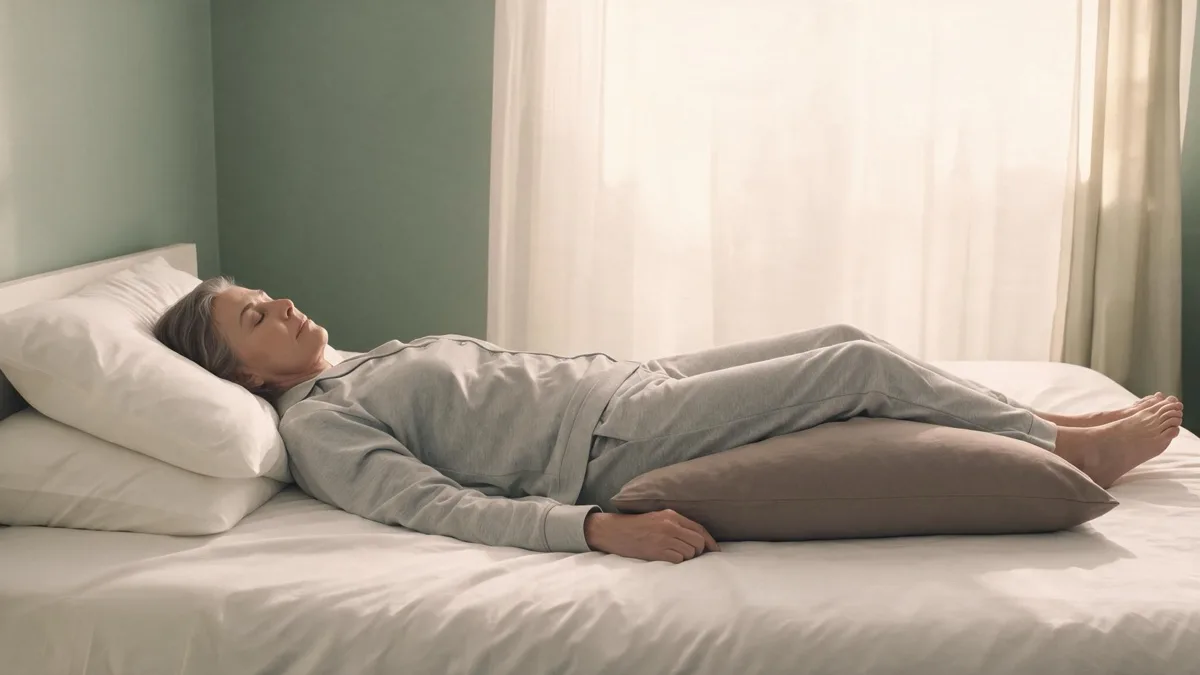
Back sleeping with support under the knees reduces the arch in the lower spine and takes load off the nerve roots. This is our fallback on nights when side sleeping will not settle.
- Lie on your back
- Raise both knees by roughly 15 to 20 cm with support underneath
- Let the lower back flatten naturally into the mattress
- Apply the Sleep Shuffle if the pain persists once you are settled
Stacked pillows slide apart during the night and you wake up with your knees flat again and the ache back. A half-moon bolster keeps the same height under both knees until morning.
 What we use
ComfiLife Knee Pillow for Back Sleeping
A half-moon memory foam bolster made to sit under both knees for back sleeping, holding the height steady instead of collapsing or sliding apart the way stacked pillows do.
Check the ComfiLife bolster on AmazonAs an Amazon Associate we may earn from qualifying purchases, at no extra cost to you.
3. The fetal position, for disc-driven pain
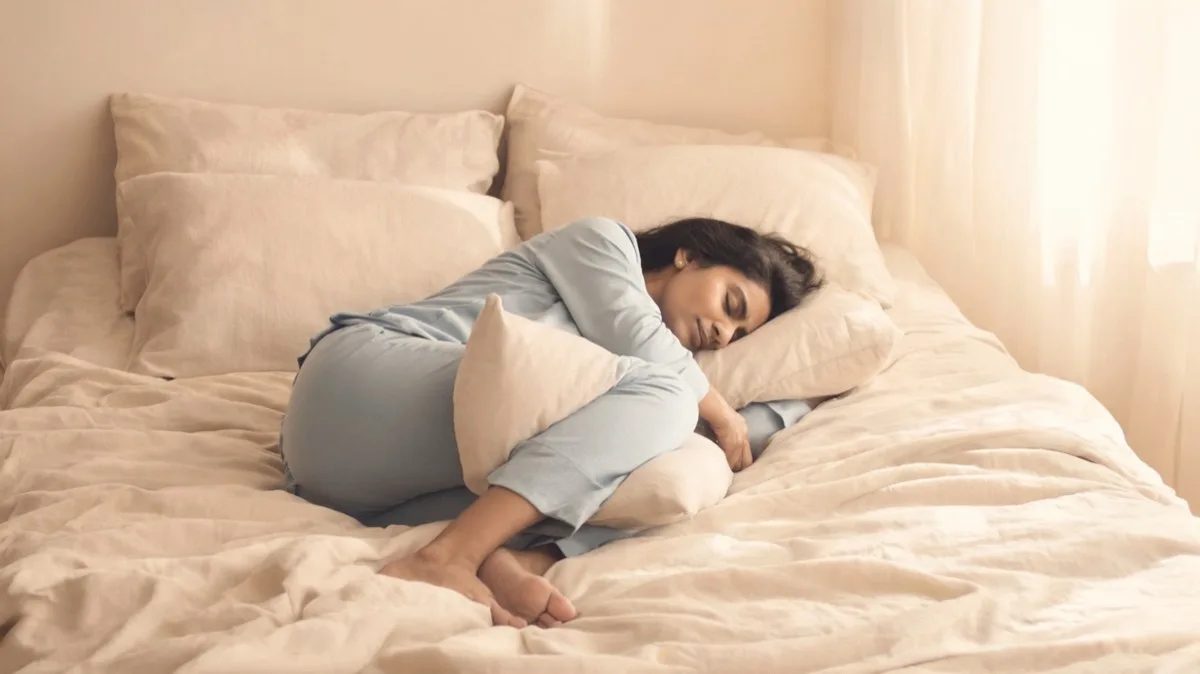
If your pain is driven by a disc bulge, meaning it worsens when you lean back and eases when you curl forward, the fetal position may suit you better than a neutral side position. Curling gently opens the space between the vertebrae and can take pressure off the nerve root.
- Lie on your side and bring both knees up toward your chest
- Keep the spine in a relaxed C-curve rather than clenching into a tight ball
- Keep a pillow between the knees
- Try both sides. One is usually noticeably better than the other
If curling forward makes your pain worse rather than better, that is useful information. It suggests the compression is not disc-driven, and the flatter back-sleeping setup is likely to serve you better.
The worst sleeping position for sciatica
Stomach sleeping. We never do it, and it’s the one position worth actively training yourself out of.
Lying face down pushes the lumbar spine into extension, which narrows the space the nerve roots pass through and increases pressure on the discs. It also forces you to turn your head to one side for hours, which adds a neck problem to the one you already have. Everything that makes the other three positions work, a neutral spine and an untwisted pelvis, stomach sleeping undoes.
There is a second position worth avoiding that gets less attention: side lying with the top leg rolled forward onto the mattress. It looks like side sleeping but it twists the pelvis against the spine and holds it there all night. That is exactly what the pillow between the knees is there to prevent.
If you are a lifelong stomach sleeper, do not expect to change in one night. Start in a side position with a pillow between the knees and a second pillow hugged against your chest, which gives your arms something to do and makes rolling face down less tempting.
Moving in bed without waking the pain
One of the most underrated parts of sleeping with sciatica is how you move once you are in bed. Rolling over carelessly can trigger a pain spike that takes twenty minutes to settle.
The technique that works for us is the log roll: keep the whole trunk still and move your shoulders, hips and knees together as one unit, rather than twisting at the waist. Getting out of bed works the same way. Roll onto your side first, drop your legs over the edge, and push yourself upright with your arms instead of sitting straight up. It takes practice, and it makes a real difference to mid-night position changes.
If sciatica wakes you in the night
Lying there hoping it passes rarely works. The faster route back to sleep is usually to get up briefly, do a gentle knee-to-chest stretch or an easy forward bend, then get back in using the side-lying setup. The movement breaks the muscular spasm that builds up during long periods of lying still, and resets the pressure that has been sitting on the same spot for hours.
Heat before bed
Fifteen minutes of heat on the lower back and buttock before bed relaxes the paraspinal muscles and the piriformis, and a tight piriformis presses directly on the sciatic nerve. Combined with the Sleep Fix it gives you the best chance of settling comfortably.
Do not apply heat directly to bare skin, and never fall asleep with a heat pad still switched on.
Does your mattress matter?
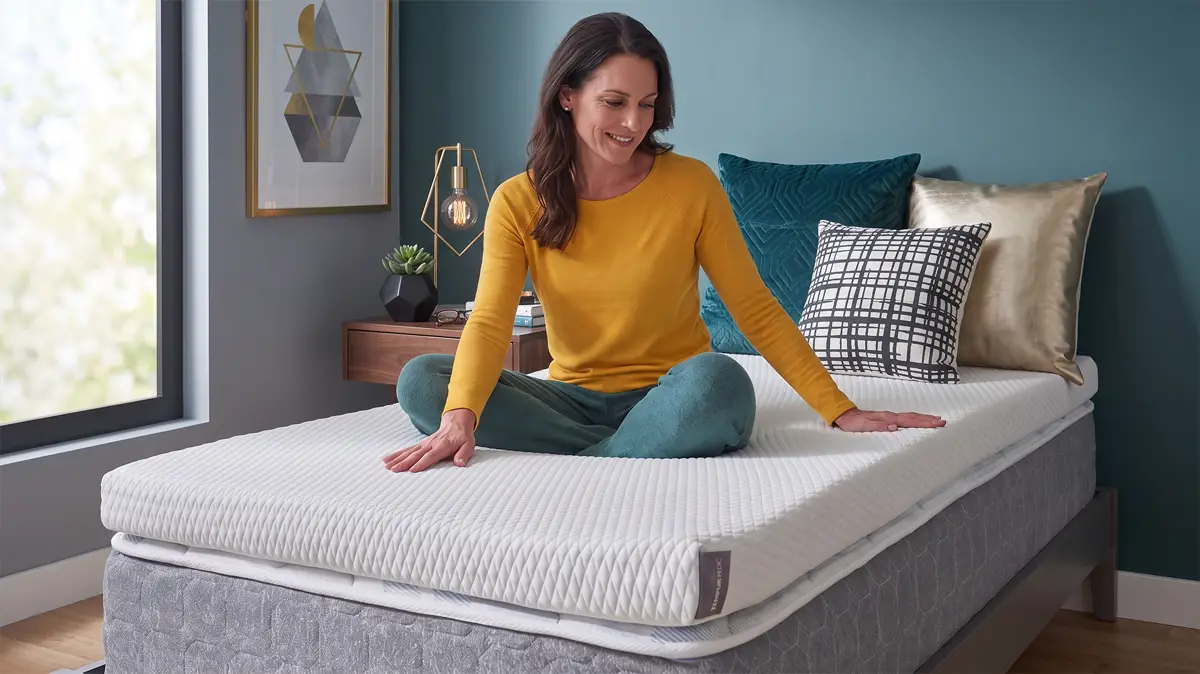
Considerably. No position compensates for a mattress that lets your spine sag out of line for eight hours a night.
The tell is simple: if your sciatica is reliably worse when you wake than when you went to bed, and you can feel yourself sinking or feel springs underneath you, the mattress is part of the problem. Medium-firm is the consensus choice for sciatica. Very firm creates pressure points at the hip and shoulder when you side sleep; very soft lets the lumbar spine drop.
If the mattress is the problem rather than the position, see our guide to the best mattress for back pain.
 Cheaper first step
ViscoSoft 3 Inch Select High Density Topper
Where the mattress is too firm or too soft rather than worn out, a topper changes how it supports you for a fraction of the cost of replacing it.
Check the ViscoSoft topper on AmazonAs an Amazon Associate we may earn from qualifying purchases, at no extra cost to you.
Track what works for you
Sciatica has a pattern specific to each person, because the compression can come from a disc bulge, a bone spur or a tight piriformis, and those respond differently. What relieves one person aggravates another.
Keeping a one-line note each morning of which position you used and how the night went will identify your pattern far faster than trial and error alone. It took us longer than it should have to work this out.
Frequently Asked Questions
What is the worst sleeping position for sciatica?
Sleeping on your stomach. It puts the lumbar spine into extension, increasing pressure on the discs and nerve roots, and forces the neck into rotation for hours. Side lying with the top leg rolled forward onto the mattress is a close second, because it twists the pelvis against the spine.
Why is sciatica worse at night?
Several things stack up. You stop making the small position changes that relieve pressure during the day, there are no distractions competing with the pain, muscles including the piriformis tighten as you cool down, and a poor position or sagging mattress holds the spine badly for hours at a time.
Which side should I sleep on with sciatica?
Generally the side opposite your pain. If sciatica runs down your right leg, sleep on your left. Then use the Sciatica Sleep Shuffle to fine-tune your hip position once you are in bed.
How do I stop sciatica pain at night?
Do a gentle pre-bed routine such as our Great Sciatica Sleep Fix to release muscle tension before you lie down, then use the Sciatica Sleep Shuffle to find the position that relieves nerve pressure. A firm pillow between the knees and a supportive mattress complete the approach.
Should I use a firm or soft mattress for sciatica?
Medium-firm suits most people with sciatica. A very firm mattress supports well but creates pressure points at the hip and shoulder when side sleeping. A very soft one lets the spine sag. Medium-firm supports the spine while still giving enough for the hips and shoulders.
Is it better to sleep with sciatica or stay awake?
Sleep, every time. Sleep deprivation measurably worsens pain perception, and sleep is when tissue repair happens. Getting sleep with some discomfort beats waiting for the pain to disappear before you attempt it. Use the positioning and the pre-bed routine to make it as comfortable as you can.
When to seek medical help
See a doctor if sciatica or back pain does not improve after a few weeks or keeps worsening. Seek urgent care (call 911 or go to your nearest emergency room) for numbness around the genitals or buttocks, trouble urinating, or loss of bladder or bowel control.
Related reading
- The complete guide to sciatica and sleep
- Sciatica flare-up: the first 24 hours
- How to relieve sciatica pain
- Sitting with sciatica without making it worse
- The best mattress for back pain
This guide combines personal experience of living with sciatica and back pain with guidance from the medical sources below. It’s general information, not a diagnosis or medical advice. See our medical disclaimer.
Sources and further reading
Was this guide helpful?
Thank you. Your feedback helps us improve.